What an awesome 2013 Fall DACTM/MDSTA Conference! It was wonderful meeting so many elementary educators and having intellectual mathematical discussions!
Some of the many new ideas that I learned at the conference include:
1.Open-ended math questions
Teachers, we need to work smarter, not harder! Think about open-ended questions as a natural answer for how to differentiate in the math classroom! Instead of giving students the question all the time, give them the answer and have them become the teacher!
For example:
"The answer is 34. What is the question?"
Oh my goodness! There are so many possible questions! This technique allows students to pick their "just-right" math level and "answer" the "question" accordingly. Some possible solutions are:
1. What is 30+4?
2. What is (2x15)+4?
3. What is (3x10)+4?
4. There are 15 animals in the north end of the zoo. If there are 19 animals in the south end, how many total animals live at the zoo?
There are so many options to this type of problem. I use these all the time and I really feel that I can understand my students better;along with where they stand in their mathematical thinking. I have many open-ended word problems in my tpt store attached to word problem sets. Be sure to check them out!
2. Sumoku
This seems like an awesome game for higher order skills while adding numbers. Think "sudoku meets addition in lower elementary" with this crossword-like numbers game. Click here for the full version of the 5 different ways to play. There seems to be a version you can purchase via Amazon and a web-based version.
3. Hundreds Grid Puzzles
I actually learned about this wonderful technique from a now retired 3rd grade teacher, but having a refresher was helpful. The idea is that you take cardboard copies of a hundreds grid and cut them into 7 or more pieces. Then it is the student's job to reconstruct the hundreds grid.
This is often more difficult than it sounds for students and is a wonderful partner activity for building numeracy and it can be used as a quick individual formative assessment.
I would suggest making a labeling system for each puzzle (and placing that on the back of each piece), laminating each piece, and placing the entire hundreds grid set in one envelope (with the same label) for added durability.
4. "Making sense takes time, over time. Do we give our students this time?"
This quote really got me thinking. I, as a teacher, am always wishing that I had more time to plan, or converse with my colleagues, or make copies, or grade papers, or.....let me stop because my list could go on and on. But seriously, this quote made me wonder if maybe students feel the same way with their thinking and learning within the classroom. Are students secretly wishing they had more time to make sense of what they are expected to learn?
Dedicated student-teacher preparation courses and best practice documents instruct teachers to use "wait time", but that lasts at most 30 seconds. Students might need an hour, day, or even a week, (or longer) in order to truly make sense of a concept. We, as educators, have to remember that our introduction might be the first time that students are exposed to a concept. It is impossible to become an expert or to say "I've got it!" after one math workshop session with some of the difficult and complex tasks we expect our students to complete.
We owe it to our students to give them the time that they need to be successful and to develop new connections and background knowledge for their learning. We need to slow down and start explicitly planning for this "sense-making time".
I would like to thank all of the presenters at this year's conference for taking a risk and sharing your thinking, passion, and resources with other educators!
I am looking forward to next year's conference!
Your turn: What are the top 3 "take-aways" from the last conference you attended?
Hello everyone! I am so excited for the 2013 DACTM/MDSTA Fall conference this weekend! This year is sure to be a sucess and filled with many intellectual discussions, new exciting techniques, and wonderful resources. I will be passing out my best-selling "Math Talk" Bookmarks for free!
So the start to this school year has been a little insane with scheduling! Between whole class assessments and individual testing, it doesn't feel like I've had much time to really sit down with my students to get our math workshop going the way I would have liked to during September. Needless to say, we have restarted "The First 14 Days of Math Workshop" because my teaching partners and I decided to start switching for the subject of math. I love this because it gives me a new, fresh set of minds in which to explore math (and another chance to introduce math workshop!)
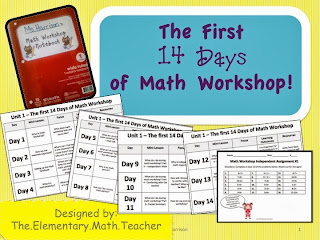
Today we actually meshed sessions 7 and 8 of "The First 14 Days of Math Workshop" together and it worked out very well. Over the weekend, I divided my students into partnerships and then combined two partnerships together to create groups of 4. I ended up having 6 groups in total. This way students will have one person to work with during their partner math activities and a whole group to come to when we are completing assignments that have a limited number of tools or those which will require a group presentation at the end.
I prepped for the characteristics of a strong math partner lesson by printing out the enlarged completed puzzles onto cardstock, cutting out the pictures along their borders, and then further dividing them into 11-13 pieces.
I then numbered the backs of each set of puzzle pieces (I ended up with 12 sets) and placed completed sets in their matching envelopes. This prep made starting the partner math activity super easy and quick.
I shortened the actual mini-lesson (session 8) from the unit a little by simply asking for suggestions of ways to be a strong math partner without writing down these suggestions. I then used my computer and projector (thank you technology!) to display the poster of the Characteristics of a Strong Math Partner for everyone as we went through each row.
Before I sent students off, I did open one of the sets and showed them some of the pieces to build excitement for the puzzles they were about to work with in partnerships!
Due to scheduling conflicts, we only had 40 minutes for our lesson, so I had to forfeit individual math conferring. I simply walked around to partnerships and narrated the characteristics of a strong math partner that I witnessed. I also had to let go of the independent math portion because I felt that the carpet summary of what a strong math partner looks and sounds like was more important for the beginning days of math workshop.
Overall, it was a very effective, fun, and quick lesson. We will continue to use these bookmarks and the poster to reinforce these characteristics.
How are you building strong math partnerships in your classroom?
Happy first day of school to everyone who started September 3, 2013!
I hope you had an amazing day and have a fabulous week filled with learning, patience, and, and mashmallow toes in the hallway!
.PNG)


