Friday, July 29, 2016

DIY PLACE VALUE BOX


Head to the Dollar Store to pick up the following items to make this super easy and handy place value box for your classroom!

List for making one DIY Place Value Box:
-3 tongue depressors 
-3 paper cups (3 oz. size)
-Sturdy Plastic Container
-Clear tape
-Decorative Duct Tape (optional) 
-permanent marker
-scissors
-20 bright green pony beads
-15 bright blue pony beads
-10 bright purple pony beads
-2 black pipe cleaners (cut in half)


Step 1: Cut the pipe cleaners in half.

Step 2: String the green pony beads to one pipe cleaner, the Blue to a second pipe cleaner, and the purple beads to a third pipe cleaner. There will be one pipe cleaner left over.  Set these aside.

Step 3: Cut the bottoms out of your paper cups. You might even be able to just use your finger and pop out the bottom on the less expensive options.

Step 4: Write out "H" on the top of the first stick, "T" on the second, and "O" on the third. Each stick will represent one place.

Step 5: Tape each stick to the inside of your box. Make sure they are in the "H,T,O" order!

Step 6: Slide a paper cup onto each stick and tape to the stick to secure.

(Optional)Step 7:Add your fancy duct tape to make the box your own!

Voila! There's your DIY kid-friendly kinesthetic place value box.  Students can drop the pony beads through the cups in order to add and to help with place value.


1's = Green Beads
10's = Blue Beads
100's = Purple Beads

Students can make their own to have in the classroom or you could have some pre-made for a center.

This can be used for independent or group practice in addition to an informal assessment.

Click here for a free task cards download you can use with this box.

--->TAG @kidsmathtalk on Instagram or Twitter with a pic of your place value boxes!  

Sunday, April 3, 2016

3 Tips for Starting a Unit on Time

How well do your students really understand time?


Even after giving my students a pre-test  on telling time and solving elapsed time word problems, I greatly misjudged their ability to tell time on an analog clock as well as to think about how long before the next hour.

After crashing and burning with several elapsed time number line lessons, I decided to rethink my approach and to consult the Common Core State Standards prerequisite  understandings for time. From here I came up with three tips to help my students with their conceptual understand of the analog clock and telling time.


Tip #1: Make sure students know the hour time zones


Start your time unit with by giving students a common understanding of the "hour zones" on an analog clock. Use their schema about an "AB" pattern and divide the clock into 12 parts.  


Tip #2: Give students resources to help them find the 
                         minutes on the clock


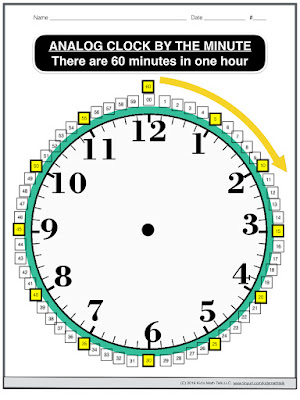
Sometimes part of the trouble for telling time is knowing how to move CLOCKWISE on a clock and how to figure out where specific minutes on the clock are when given a problem. 

Give students this page to use as a resource when working with time! The "clock facts" used for skip counting by fives even have a thicker border to help them stand out.


                                   Tip #3: Practice, Practice, Practice!


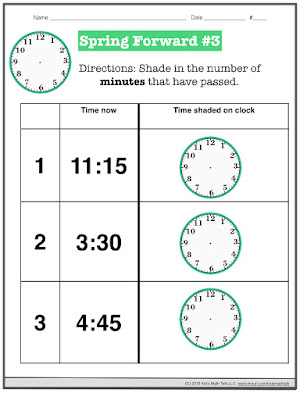
Give random times and have students shade in the number of minutes on the clock. This will help them start to recognize the concept of moving clockwise as well as the total area a number of minutes takes on the clock.

Also, relating time to fractions of 60 minutes can help students estimate times while they are learning how to be very precise


Starting our unit over and focusing on these three tips has greatly improved the understanding of time in my classroom.


All of these sheets and more are included in my
Winter Elapsed Time Pack!

  Click on the picture to grab it now while the price is only $3.00!! 


Also try out the  Spring Activity Pack!


Try out the pages specifically for these three tips for free 
by clicking on the link below...
       

Leave a comment about how your are helping your students understand time!

Sunday, January 24, 2016

Minute Math Sessions for Parents

I have been thinking of how to better reach the families of my students and help them with using math strategies at home. There never seems to be enough time, but if someone is really worth it, then I just need to make the time for it.

With that in mind, I came up with the idea of a
 "Minute Math Session" for Parents 


This is a lightning speed, 15 minute tip session for parents. I am doing it during my lunch hour, and I hope that if this is successful, that I can turn over the strategy "showings" and have them as leadership opportunities for my students.
---------------------------------------------------------------------------------
Here's my idea:

1. Parents RSVP for the event.

2. Parents will come to my room at the start of my lunch period on the day of the event.

3.I spend 2-4 minutes introducing to one or two math strategies we are using in the classroom.

4. Parents get a copy of the supplies/materials needed and get some hands-on practice time with me.

5. Ask Questions!

6. Parent take materials and leave.


The first one is this Friday - here is the one of the tips. 
You can click on the image too to grab the freebies!


 I'll post how it goes!


How are you reaching out to your families to help with math strategies?

Sunday, January 10, 2016

My Life as a Mathematician


What is your math story? 


Over the summer I received the book, The Impact of Identity in K-8 Mathematics: Rethinking Equity-Based Practices by Julia Aguirre, Karen Mayfield-Ingram, and Danny Bernard Martin. 


It has been a really eye opening read where I am starting to think more deeply about my own math identity and how my past experiences have shaped how I teach math today.

If you stepped into my classroom today, you will see math talk posters, anchor charts, fancy math displays, and an array of math targets and goals for my 3rd grade students.  Math is a constant and a welcome necessity in my classroom and I am known by my students and other teachers as a person who loves math. I am even the Vice-president for elementary of an NCTM affiliate here in Michigan and love talking math on Twitter each week. 

My actions and thoughts today, however, are almost the complete opposite of how I felt about and approached math in middle school and high school. I always knew it was a necessity, but I just didn't get it. I didn't understand the "why". I did have all sorts of questions floating in my mind during a math lecture:


No one had ever told me that it was okay to ask these types of questions in math and since I was the type of student that did exactly as she was told, I never asked my questions. I always got decent grades in math, but because I never developed any true conceptual understanding I still always felt as if I was struggling.


My love for the subject began when I had to start teaching it to others. I felt the urgency to develop my understanding and really dig deeply into the concepts so that I would be able to help my students. When I started answering the questions I had been asking in my mind for years, math became a subject of beauty to me. The connections, patterns, specific vocabulary, and amazing reality of math in nature is fascinating to me. Understanding math at a deeper level has changed how I view my world. 

I work so tirelessly with the subject and continue to read about it and go back to school to increase my knowledge to understand multiple ways to help my students make math connections with their worlds. I want students to understand that math is about problem solving and question asking and pattern noticing- I also want them to embrace these aspects in order to truly become empowered.

I would not have written about my math identity without this book nor would I have started to think about math equity in the classroom. I loved this process so much that I would like to share it with others. I thought one easy way to get this started would be to start a Twitter chat!


Join me for the new #mathequity chat starting January 24, 2016 @8pm EDT. You do not need to have the book read in order to participate! Everyone has experience to share and I look forward to hearing your perspectives.

What is your math story? 


Welcome to Kid's Math Talk, LLC!

Welcome to Kid's Math Talk, LLC!
My name is Desiree and I am super passionate about math education and best practices for students and their teachers. Thanks for stopping by my blog!

LinkWithin

Related Posts Plugin for WordPress, Blogger...